

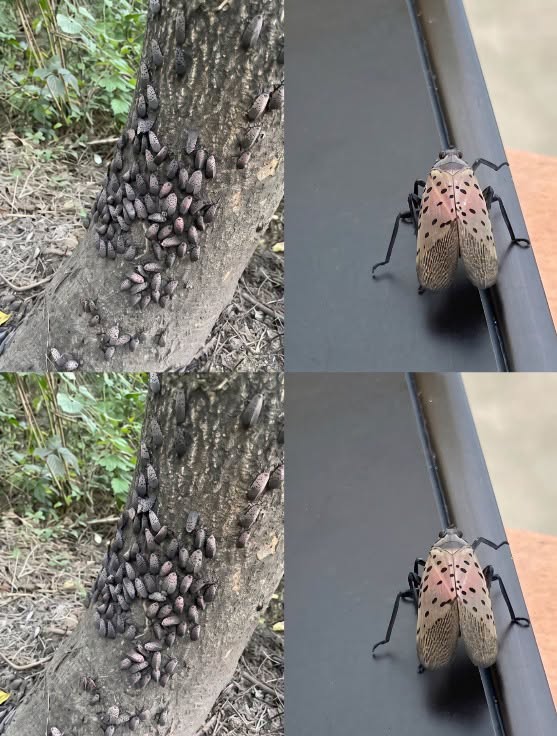
Knowing what you’re looking at is important because plenty of insects have spots, wings, or unusual colors.
Adult spotted lanternflies are roughly an inch long. Their folded forewings are grayish with black spots, giving them a somewhat camouflage-like appearance.
When the wings open, however, the insect becomes much easier to recognize because of the striking red coloration on the hindwings.
Young lanternflies look different
The immature stages, called nymphs, don’t immediately resemble the adults.
Early nymphs are small, black insects marked with white spots. As they mature, they develop red coloration along with their black-and-white markings.
That means you may encounter several dramatically different-looking versions of the same insect during the season.
Don’t Forget About the Egg Masses
One of the most important things to look for isn’t an adult insect at all.
Spotted lanternfly egg masses can appear as grayish or brownish patches that resemble a smear of dried mud.
They may be found on tree trunks and branches, but the insects aren’t limited to living plants. Egg masses can also occur on hard outdoor surfaces and objects, making them especially useful to recognize when checking for possible spread.
This matters because lanternflies can hitchhike from one location to another on outdoor items, vehicles, equipment, and other surfaces.
What Should You Do If You Find One?
The correct response depends partly on where you live and whether spotted lanternflies are already established in your area.
If you encounter an individual insect, physical removal can be appropriate for a small number of adults or nymphs. However, don’t assume that every spotted insect is a lanternfly.
If you’re unsure about the identification, take a clear photograph and compare it with identification information from your local agricultural or environmental authority.
In areas where the species is being monitored, reporting sightings can also help officials understand how populations are spreading.
Don’t automatically reach for pesticides
Seeing one insect doesn’t necessarily mean you need to spray your entire yard.
Broad pesticide applications can affect beneficial insects and other wildlife, so treatment decisions are best based on the severity of the infestation and local recommendations.
For larger infestations, professional pest-management advice may be appropriate.
What About the Egg Masses?
If you find a suspected egg mass, don’t simply brush it onto the ground.
Management recommendations can vary by location, so check guidance from your local agriculture or environmental agency for the approved method of removal and disposal.
The important thing is to recognize that an egg mass represents future insects, not just something unpleasant stuck to your tree.
Why Do They Spread So Easily?
One reason invasive insects are difficult to manage is that humans unintentionally help them travel.
A lanternfly doesn’t have to fly enormous distances on its own to reach a new area.
Egg masses and insects can potentially move when attached to vehicles, outdoor equipment, firewood, landscaping materials, and other objects.
That makes simple habits—such as checking outdoor items before transporting them—an important part of limiting accidental spread.
What Plants Do They Attack?
Spotted lanternflies can feed on many plant species.
One particularly important host is the tree of heaven, an invasive tree that lanternflies strongly favor. They can also feed on a variety of other trees, vines, ornamentals, and agricultural plants.
Grapevines and certain fruit trees can be especially important concerns in agricultural areas.
However, it’s worth remembering that seeing a lanternfly on a plant doesn’t automatically mean the plant is going to die. The severity of damage depends on factors including the number of insects, the plant species, and the duration of feeding.
Do Spotted Lanternflies Bite People?
No.
Spotted lanternflies aren’t looking for humans. They feed on plant sap and aren’t considered insects that bite or sting people as part of their normal behavior.
So the concern is primarily plants, agriculture, and the potential ecological effects of an invasive species, not direct danger to your family.
That distinction is important because viral posts about insects can sometimes make an environmental problem sound like a personal safety emergency.
A Few Smart Things You Can Do
If spotted lanternflies are present in your region, a little awareness can go a long way.
Check your plants
Pay particular attention to trees and other plants where you notice unusually large groups of insects.
Learn the different life stages
Don’t look only for the red-winged adult. Young nymphs and egg masses look completely different.
Inspect outdoor belongings
Before moving vehicles, equipment, furniture, or other outdoor items from an affected area, check them for insects and egg masses.
Follow local instructions
Invasive-species management is highly dependent on location. Local agricultural departments and environmental agencies can provide the most relevant recommendations for your area.
The Bottom Line
The spotted lanternfly is certainly an insect worth recognizing, particularly if you live in an area where populations are established or being monitored.
Its unusual appearance can make it seem fascinating rather than threatening, but its ability to feed on plants, produce honeydew, and spread to new areas has made it an important invasive-species concern.
Still, there’s no reason to panic when you see an unfamiliar bug.
Identify first. Act appropriately. Follow local guidance.
And if the insect really is a spotted lanternfly, dealing with an isolated bug or reporting a sighting can be far more useful than simply ignoring it.
Sometimes the most important thing in your garden isn’t knowing which insects to fear—it’s knowing which ones deserve your attention.