
Step Four: Don’t Corner the Snake
A snake that feels trapped may become defensive.
If you block every possible escape route, the animal may feel that it has nowhere to go.
That’s when defensive behavior can become more likely.
Instead of surrounding it, give it space.
If the snake is in a room and you can safely leave without getting close, move away and close the door from a safe position if possible.
This can help contain the animal until professional assistance arrives.
Step Five: Give It an Escape Route—If It’s Safe
If the snake is near an exterior door and you can safely open the door without approaching the animal, providing an exit may allow it to leave on its own.
However, don’t try to herd it toward the door.
Don’t chase it with a broom.
Don’t throw objects.
Don’t attempt to physically move it.
The safest solution is often to reduce the disturbance and let the snake move away naturally.
If opening a door requires getting close to the snake, don’t do it.
Your safety comes first.
Step Six: Identify the Snake From a Safe Distance
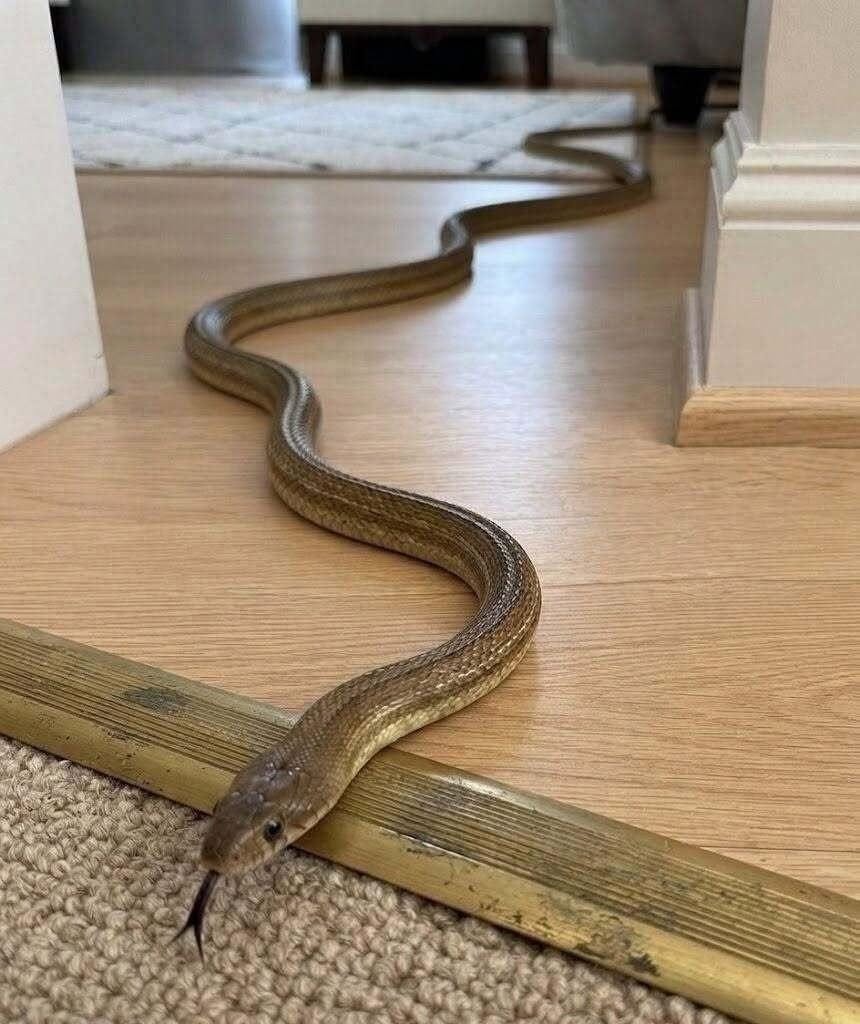
If you can do so safely, take note of the snake’s appearance.
Useful details can include:
Approximate length
Body color
Pattern
Head shape
Location
Behavior
Whether it is moving or hiding
A photograph may also help professionals identify the animal.
But don’t move closer simply to get a better picture.
A blurry photograph taken from a safe distance is much better than a perfect photograph taken from dangerous proximity.
And avoid relying on social media comments for definitive identification.
Snake identification can be difficult, particularly when lighting, distance, and regional variation are involved.
What If You Don’t Know Whether the Snake Is Venomous?
Treat an unknown snake with caution.
Don’t assume:
“It looks harmless.”
Don’t assume:
“It’s probably just a garden snake.”
And don’t assume:
“Venomous snakes always look aggressive.”
Snakes don’t have to display obvious aggression to be dangerous.
If you cannot confidently identify the species, maintain your distance and contact a local wildlife professional, animal-control service, or other appropriate authority.
The exact organization available will depend on where you live.
What If the Snake Disappears?
This is where many people make another mistake.
You see a snake disappear behind a cabinet or under furniture and immediately start moving everything around to find it.
Don’t.
If you can’t see where the snake went, don’t put your hands into dark spaces.
Don’t reach underneath furniture.
Don’t stick your fingers into holes.
Don’t blindly move boxes.
A snake hiding somewhere is not an invitation to start searching with your hands.
If possible, isolate the area and seek professional assistance.
Don’t Use Your Hands to Search Dark Spaces
This rule applies whether you see a snake or not.
Snakes can hide in surprisingly small spaces.
A dark gap under a cabinet may look empty while still providing shelter.
If you need to move something, use appropriate caution and avoid placing your hands where you cannot see.
This is especially important in garages, sheds, crawl spaces, and storage areas where snakes may be present.
What About Children?