
Different honeys naturally have different characteristics.
Floral source can influence sugar composition, flavor, color, aroma, and crystallization behavior.
The way honey is harvested and processed can also affect its final appearance and texture.
Raw honey, filtered honey, strained honey, and processed honey may not look identical.
Even within the same broad category, batches can differ.
This means consumers should be cautious about viral claims suggesting that there is one “correct” way for real honey to look.
Nature rarely works according to such simple visual rules.
What Should You Look for When Buying Honey?
If your goal is to purchase high-quality honey, there are more useful approaches than relying on a bottle-flipping test.
Start with the label.
Look carefully at the ingredient list.
If the product is sold simply as honey, you should expect honey to be the listed ingredient rather than a mixture containing additional syrups or sweeteners.
Be cautious when labels are unclear or make unusual claims that cannot easily be verified.
You can also consider buying from producers with transparent sourcing information and established reputations.
Local beekeepers, reputable honey producers, and suppliers who clearly identify the origin of their honey can provide more information than a mysterious product with limited labeling.
“Raw,” “Natural,” and “Pure” Are Not Magic Words
Marketing language can also create confusion.
Words such as “natural,” “pure,” “raw,” and “premium” can sound reassuring, but consumers should still evaluate the product as a whole.
“Natural” does not automatically mean that a product has been independently verified.
“Raw” refers to how honey is handled or processed, but it is not itself a universal guarantee of authenticity.
“Pure” is also a claim that should be considered in the context of labeling standards and applicable regulations.
Rather than relying on one word printed on the front of a bottle, look at the ingredient list, producer information, origin, and overall labeling.
Taste Is Not a Reliable Laboratory Test Either
Some people believe they can identify pure honey simply by tasting it.
Continued on next page 👇(page 4)👇
associated with particular floral sources, but taste alone cannot reliably establish whether a commercial honey has been adulterated.
A sweet syrup can also taste sweet.
Flavor differences can arise from the flower source, processing, storage, age, and other factors.
Taste can help you decide whether you enjoy a particular honey.
It cannot substitute for analytical testing.
What Actually Provides Stronger Evidence?
When authenticity truly matters—for example, in commercial food production, regulatory inspection, or scientific research—laboratory analysis is the appropriate tool.
Professional testing can investigate the chemical composition of honey and identify patterns that may suggest adulteration.
The exact method depends on the question being asked and the type of adulteration suspected.
This is why a simple home test should never be presented as definitive proof.
At-home experiments can be entertaining and educational.
They are not equivalent to food-authentication testing.
The Bigger Lesson About Viral Food Tests
The honey bottle trick is part of a much larger trend.
Social media is full of simple tests that supposedly reveal whether food is “real,” “fake,” “toxic,” “healthy,” or “dangerous.”
Some are based on legitimate scientific concepts.
The problem is that a real scientific concept can be turned into an incorrect conclusion.
Viscosity is real.
Crystallization is real.
Density is real.
Chemical reactions are real.
But observing one physical property does not necessarily allow you to determine the entire composition of a food.
That is the critical mistake behind many viral food tests.
A Simple Test Can Be Fun Without Being Proof
There is nothing wrong with flipping your honey bottle to see how it behaves.
It can be a fun experiment.
You can even repeat the test after warming the honey slightly and observe how its flow changes.
That can demonstrate a real scientific principle: temperature affects viscosity.
But don’t let the experiment convince you that you have performed a definitive purity test.
The correct conclusion is much more modest:
“This honey is behaving in a certain way under these conditions.”
That is useful information.
It simply isn’t the same as saying:
“This honey has been scientifically proven to be pure.”
How to Store Honey Properly
Regardless of how you test your honey, proper storage matters.
Honey should generally be kept in a clean, tightly closed container at room temperature and away from excessive heat and moisture.
Avoid introducing water or wet utensils into the jar unnecessarily.
Moisture can affect honey’s stability and, under certain conditions, contribute to fermentation.
Crystallization is not a sign that honey has necessarily gone bad. If desired, crystallized honey can often be gently warmed to return it to a more fluid consistency.
Avoid excessive heat, particularly if preserving delicate flavor characteristics is important.
The Bottom Line
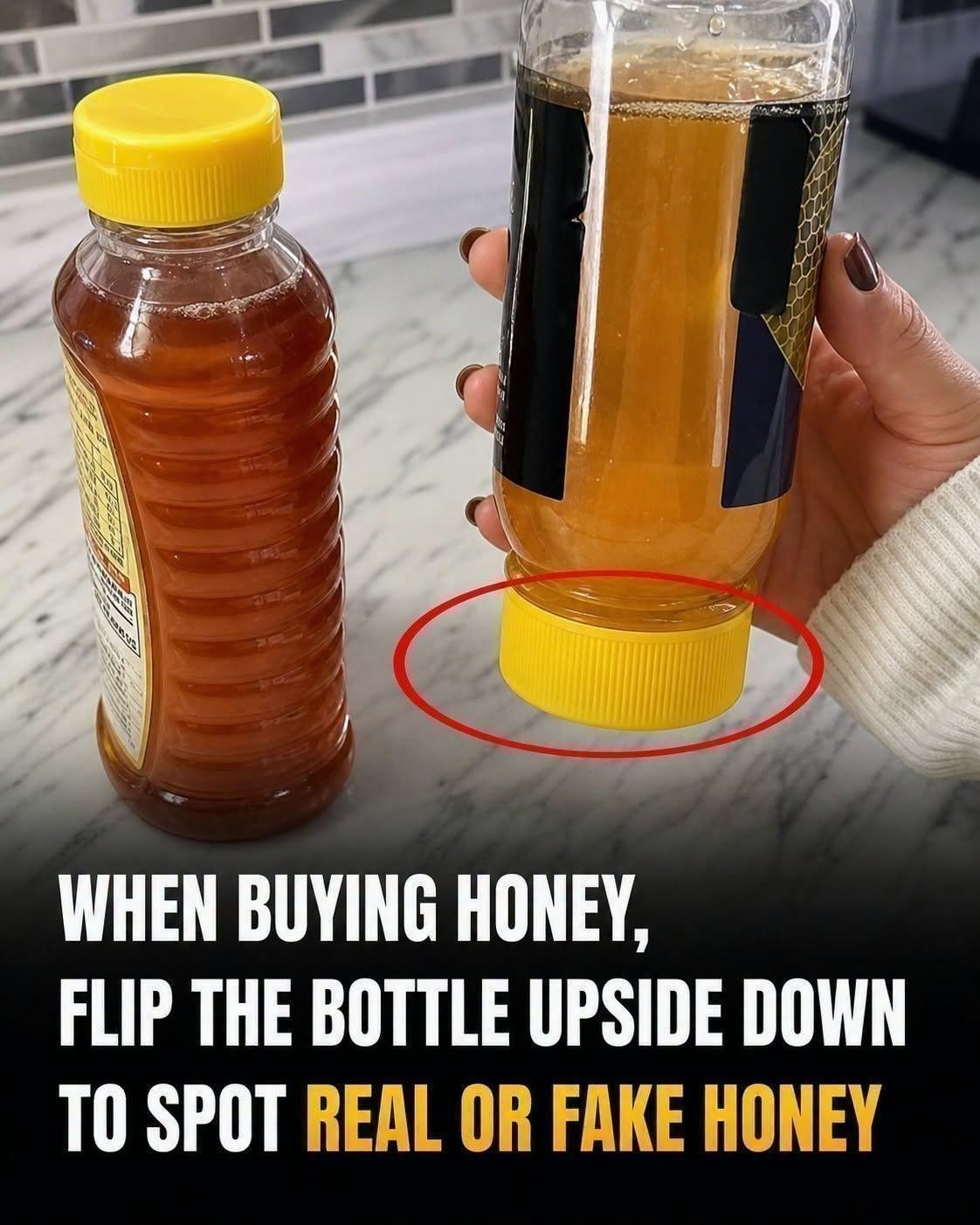
So, can flipping a honey bottle tell you whether it’s real?
Not reliably.
The way honey moves when you turn a bottle upside down is influenced by viscosity, temperature, moisture content, sugar composition, the variety of honey, and the design of the container.
A thick, slowly moving honey is not automatically pure.
A thinner honey is not automatically fake.
A slowly rising air bubble is not definitive proof of authenticity.
And crystallization does not mean the honey is counterfeit.
The bottle-flipping trick can be an interesting demonstration of the physical properties of honey, but it should not be treated as a scientific authentication method.
If you want to make a more informed purchase, pay attention to the ingredient list, labeling, producer information, and source of the honey. When definitive verification is necessary, professional laboratory testing is far more reliable than any viral home experiment.
Ultimately, the most important lesson is simple:
Don’t judge the authenticity of honey by one trick.
Honey is a natural product with considerable variation, and its appearance and texture can change for many legitimate reasons.
So go ahead and flip the bottle if you’re curious.
Just remember that what you see may tell you something about how the honey flows—not whether the honey is truly what the label says it is.