
Flip the Honey Bottle and Watch What Happens – Can This Test Really Tell If Honey Is Pure?
Honey has been valued for thousands of years for its distinctive flavor, long shelf life, and versatility. It can sweeten tea, complement breakfast foods, become part of a marinade, or simply be enjoyed by the spoonful.
But whenever people buy honey, one question often comes to mind:
Is this really pure honey?
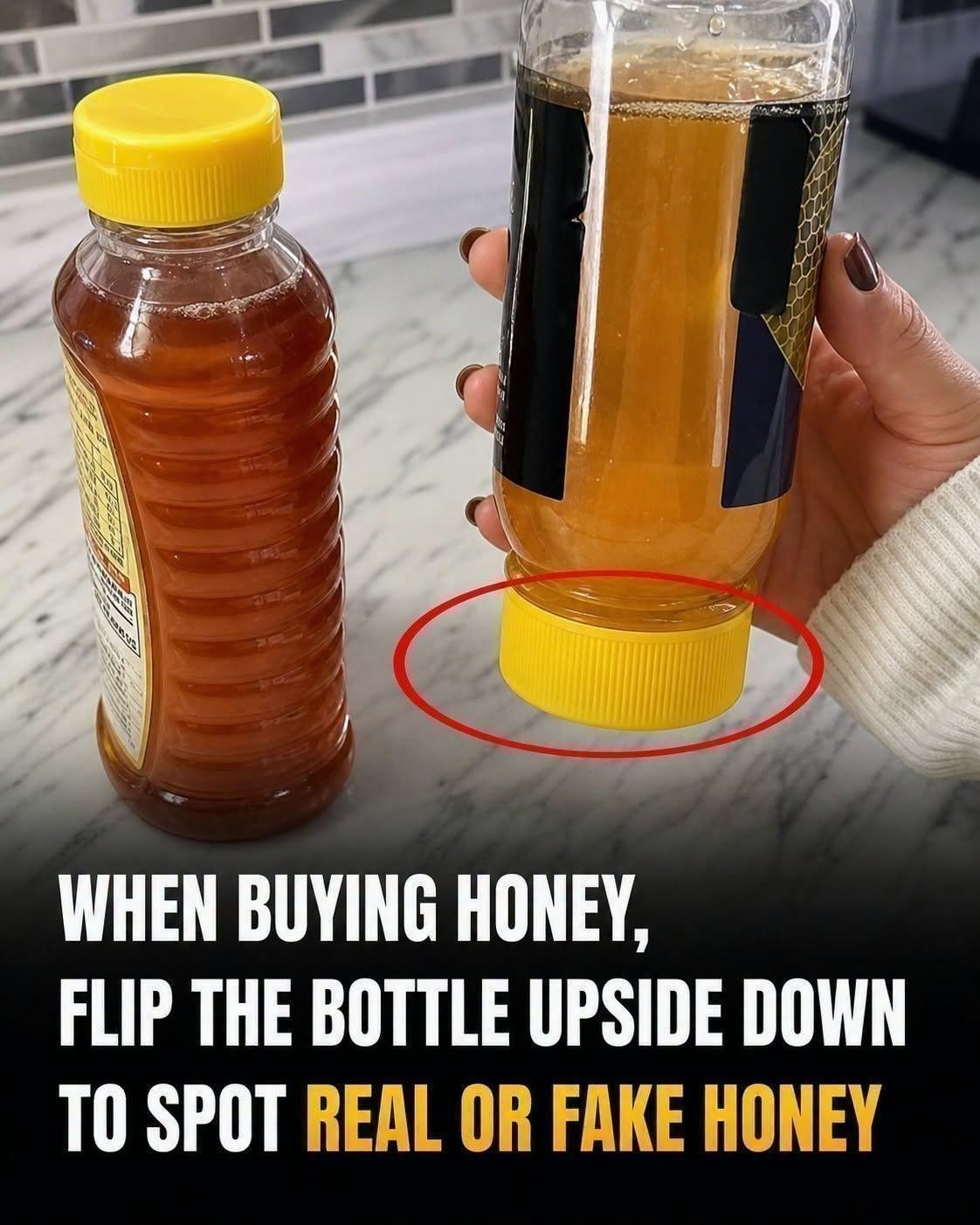
That question has become even more common as social media has popularized simple “honey tests” that claim to reveal whether a jar contains authentic honey. One of the most popular involves something that requires almost no equipment at all: turning the honey bottle upside down and watching what happens.
According to the viral claim, real honey supposedly forms a particular bubble, moves slowly, or behaves differently from diluted or fake honey.
It is an appealing idea because it seems so simple.
No laboratory.
No special equipment.
No complicated chemistry.
Just flip the bottle and look.
But can this really tell you whether honey is authentic?
The short answer is: not reliably.
The way honey moves inside a bottle can provide clues about its physical properties, but it cannot by itself prove that honey is pure, authentic, or free from added sweeteners.
To understand why, it helps to look at what honey actually contains, why it behaves the way it does, and what home tests can and cannot tell you.
Why Does Honey Move So Slowly?
The first thing you notice when flipping a bottle of honey is usually its thickness.
Unlike water, honey does not rush toward the other end of the container.
It moves slowly, sometimes leaving a thick trail behind. A bubble may travel through it gradually, while the liquid can appear almost motionless for several seconds.
This happens because honey has a relatively high viscosity.
Viscosity describes a fluid’s resistance to flowing.
Water has low viscosity, which is why it flows rapidly.
Honey has much higher viscosity, so it moves much more slowly.
But viscosity isn’t determined by authenticity alone.
Temperature, moisture content, sugar composition, crystallization, and even the type of honey can influence how thick it appears.
That is why two completely genuine honeys can behave differently when you turn their containers upside down.
What Happens When You Flip a Honey Bottle?
Imagine a bottle that is nearly full of honey.
You turn it upside down.
The honey begins to move toward the cap while an air bubble travels in the opposite direction.
Some viral tests suggest that if the air bubble rises slowly or forms a certain shape, the honey must be pure.
But this conclusion is too simplistic.
The speed of the bubble depends on several physical factor
Temperature is particularly important.
Cold honey becomes thicker and flows more slowly.
Warm honey becomes less viscous and flows more easily.
That means the exact same honey can behave differently depending on whether the bottle has been sitting in a cool kitchen, a warm cupboard, or direct sunlight.
The bottle itself also matters.
A narrow container can produce different visual effects from a wide jar.
The amount of honey, the size of the air bubble, and the angle of the bottle can all influence what you observe.
So while flipping the bottle can be an interesting demonstration of honey’s viscosity, it is not a reliable authenticity test.
Why the “Bubble Test” Became Popular
The attraction of the bottle test is easy to understand.
People want a quick way to protect themselves from poor-quality products.
Honey can be relatively expensive compared with ordinary sugar, and consumers naturally want to know whether they are getting what the label promises.
The idea that pure honey should behave in a particular way gives shoppers a simple visual rule.
If the bubble moves slowly, people may conclude the honey is real.
Continued on next page 👇(page 2)👇
If it moves quickly, they may suspect dilution.
The problem is that real food chemistry is more complicated.
There is no single visible behavior that can reliably distinguish all authentic honey from all adulterated honey.
A diluted product may sometimes be thick.
A genuine honey may sometimes flow quickly.
And different varieties of genuine honey naturally have different physical characteristics.
Honey Is Naturally Variable
One of the most important facts to understand is that real honey is not a standardized liquid.
Honey comes from different floral sources, regions, climates, and harvesting conditions.
The composition can vary naturally.
Some honeys are lighter in color and relatively fluid.
Others are darker and thicker.
Some crystallize quickly.
Others remain liquid for much longer.
Some have strong floral aromas.
Others have a delicate flavor.
This natural variation makes simple visual tests particularly unreliable.
If someone expects every jar of pure honey to look and behave exactly the same, they are already starting with an unrealistic assumption.
Crystallization Does Not Mean the Honey Is Fake
Another common misconception involves crystallization.
Many people believe that real honey should always remain liquid.
That isn’t true.
Honey is naturally rich in sugars, particularly glucose and fructose. Depending on the balance of these sugars, water content, temperature, and other factors, honey can gradually form sugar crystals.
The result is crystallized or granulated honey.
Some varieties crystallize relatively quickly.
Others may remain liquid for a long time.
Neither behavior automatically proves that the honey is authentic or fake.
In fact, crystallization is a natural process that occurs in genuine honey.
The texture may become thicker, grainier, or semi-solid, but that does not mean the honey has spoiled.
Does Clear Honey Mean Better Honey?
Not necessarily.
Another popular assumption is that high-quality honey should be perfectly clear.
Again, this is not a reliable rule.
Honey can contain naturally occurring pollen, tiny particles, or other components that affect its appearance.
Some honey is filtered more extensively than other honey
Some products are processed to produce a very clear appearance.
Color and clarity can therefore tell you something about the product’s processing or characteristics, but they cannot independently establish authenticity.
A cloudy appearance doesn’t automatically mean the honey is fake.
A perfectly clear appearance doesn’t automatically mean it is pure.
Can the Water Test Prove Honey Is Real?
Another popular home method involves placing honey in water.
The claim usually goes something like this: pure honey supposedly sinks or remains together, while fake honey dissolves quickly.
Again, this sounds scientific because it involves a visible physical reaction.
But it is not a dependable way to authenticate honey.
Honey’s behavior in water depends on its composition, temperature, concentration, and the way the test is performed.
Eventually, honey and water will mix.
The speed and appearance of that process are not sufficient to establish whether a product has been adulterated.
A dramatic reaction in a glass may be interesting to watch, but it should not be confused with a laboratory test.
What About the Thumb Test?
Another viral method asks people to place a small drop of honey on their thumb.
The claim is that pure honey will stay in place while diluted honey spreads quickly.
But once again, viscosity can vary naturally.
Temperature and moisture content influence how honey behaves.
A thick honey may remain in place longer than a thinner honey, but that does not prove that it is pure.
Likewise, a genuine honey with a naturally thinner consistency could spread more easily.
The test measures physical behavior, not authenticity.
That distinction is crucial.
Continued on next page 👇(page 3)👇
Why Adulterated Honey Can Be Difficult to Detect
Honey adulteration can involve adding inexpensive sweeteners or syrups to increase volume or reduce production costs.
Depending on the substances involved and the degree of adulteration, the final product may still look, taste, and behave surprisingly similar to genuine honey.
That is why professional food testing can be necessary.
Laboratories can analyze chemical characteristics that are impossible to identify reliably with a bottle-flipping experiment.
Methods may examine sugar profiles, isotope ratios, markers of processing, and other characteristics depending on the testing objective.
These approaches are much more sophisticated than observing how quickly an air bubble moves through a jar.
So What Can the Bottle Flip Actually Tell You?
The bottle flip isn’t completely useless.
It can tell you something about how the honey behaves under those specific conditions.
For example, you may notice that the honey is particularly thick.
You may observe that it flows slowly.
You may see that an air bubble moves gradually.
These observations can be interesting.
They can also help you understand how temperature and viscosity affect honey.
What they cannot do is provide a definitive answer to:
“Is this honey authentic?”
That requires much more information.
Temperature Can Completely Change the Result
Imagine testing the same bottle of honey twice.
The first time, you take it from a cool pantry and immediately turn it upside down.
The honey moves slowly.
The next day, the bottle has been sitting in a warm kitchen.
You perform exactly the same test.
This time, the honey flows noticeably faster.
Did the honey suddenly become fake?
Of course not.
Its temperature changed.
As honey warms, its viscosity decreases and it generally flows more easily.
This simple example demonstrates why visual flow tests are unreliable.
If temperature alone can change the result, then a single observation cannot serve as a definitive authenticity test.
The Type of Honey Matters Too