
🧈 The Secret to Really Good Mashed Potatoes
One of the simplest tricks is to make sure your dairy ingredients aren’t ice cold.
Warm milk blends into the hot potatoes more easily and helps keep everything hot.
And don’t be afraid of butter.
This is mashed potatoes we’re talking about. 😂
For especially rich mashed potatoes, you can replace some of the milk with heavy cream.
🥔 Don’t Only Use It for Potatoes!
That vintage masher has more uses than you might think.
🫘 Beans
Use it to mash cooked beans for refried beans or rustic bean dips.
🥑 Avocado
A masher can create chunky homemade guacamole.
🍎 Apples
Soft cooked apples can be mashed into applesauce.
🎃 Pumpkin & Squash
Use it to break down cooked pumpkin, butternut squash or other soft vegetables.
🥚 Egg Salad
A masher can help break boiled eggs into pieces for egg salad.
🫘 Peas
Mash cooked peas into a rustic side dish.
The Smithsonian and other historical kitchen references document mashers as tools for crushing a range of soft foods, not just potatoes. (Wikipédia)
🏡 Why These Old Tools Are So Special
Modern kitchens are filled with appliances designed to do everything faster.
Food processors chop.
Blenders puree.
Stand mixers beat.
Electric hand mixers whip.
But there is something satisfying about reaching into a kitchen drawer and pulling out a tool that requires nothing but your own hands.
The design is simple enough that you can look at it and immediately understand how it works.
That’s one reason vintage kitchen tools remain so charming.
They’re practical, durable and often built around a single purpose.
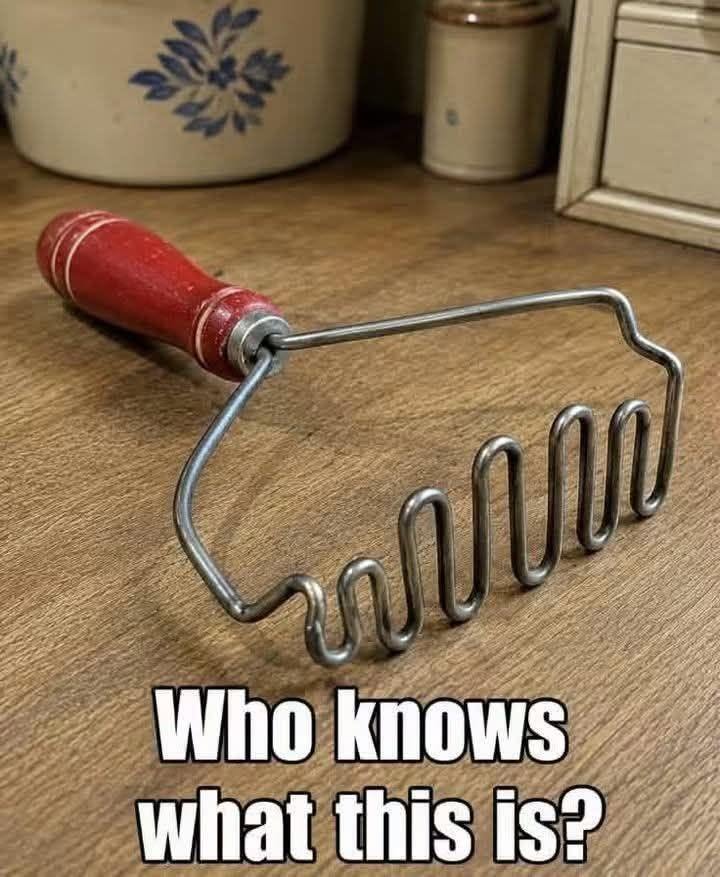
The Smithsonian’s Cooper Hewitt collection, for example, includes a circa-1935 wire potato masher with a painted wooden handle and bent steel wire head—proof that this basic style was firmly established decades ago. (Smithsonian)
🧼 How to Care for an Old Potato Masher
If you own a vintage masher and want to actually use it, inspect it carefully first.
Look for:
Rust
Flaking paint
Loose wires
Cracked wooden handles
Corrosion around the handle
Areas that are difficult to clean
If the metal is rusty or the handle has deteriorated, it’s better to use the piece as kitchen décor rather than for food preparation.
For a sound vintage utensil, wash it thoroughly and dry it completely after use.
And if it’s an antique or sentimental family piece, you may want to preserve it rather than put it through years of additional wear.
🥔 Vintage vs. Modern Mashers
The basic principle hasn’t changed much.
Modern mashers can have:
Perforated plates
Zigzag wires
Stainless-steel heads
Ergonomic handles
Silicone-coated components
The Smithsonian even has examples of modern wire mashers featuring stainless-steel zigzag heads. (Musée national d’histoire américaine)
But the job remains exactly the same:
Press, mash, repeat.
Sometimes the simplest ideas really do stand the test of time.
😂 The Kitchen Tool Test
Show this utensil to someone who grew up in the 1940s, 1950s, 1960s or 1970s and there’s a good chance they’ll recognize it immediately.
Show it to a child today and you might get:
“What is THAT?”
And that’s what makes these old kitchen tools so much fun.
They aren’t just objects.
They remind us of kitchens where meals were made from scratch, recipes were often passed down by word of mouth, and nobody needed an app to tell them how to mash a potato.
❤️ A Little Piece of Kitchen History
That funny-looking metal gadget in the photograph may not look particularly impressive.
But generations of cooks used tools just like it to make mashed potatoes, beans, vegetables and countless family meals.
It represents something we don’t always appreciate anymore:
A well-designed tool doesn’t need to be complicated.
Give someone potatoes, a pot, butter, milk and an old-fashioned masher, and they can turn a humble vegetable into one of the world’s greatest comfort foods.
And maybe that’s why so many of us still smile when we see one.
It reminds us of home.
🥔 So… Did You Know What It Was?
YES! 🙋♀️
NOPE! 🤔
I STILL HAVE ONE! ❤️
MY GRANDMA HAD ONE! 👵
If you recognized this old-fashioned kitchen tool immediately, you definitely get a few nostalgia points!
Did your family have one of these wire potato mashers—and do you still use it today? 🥔❤️