

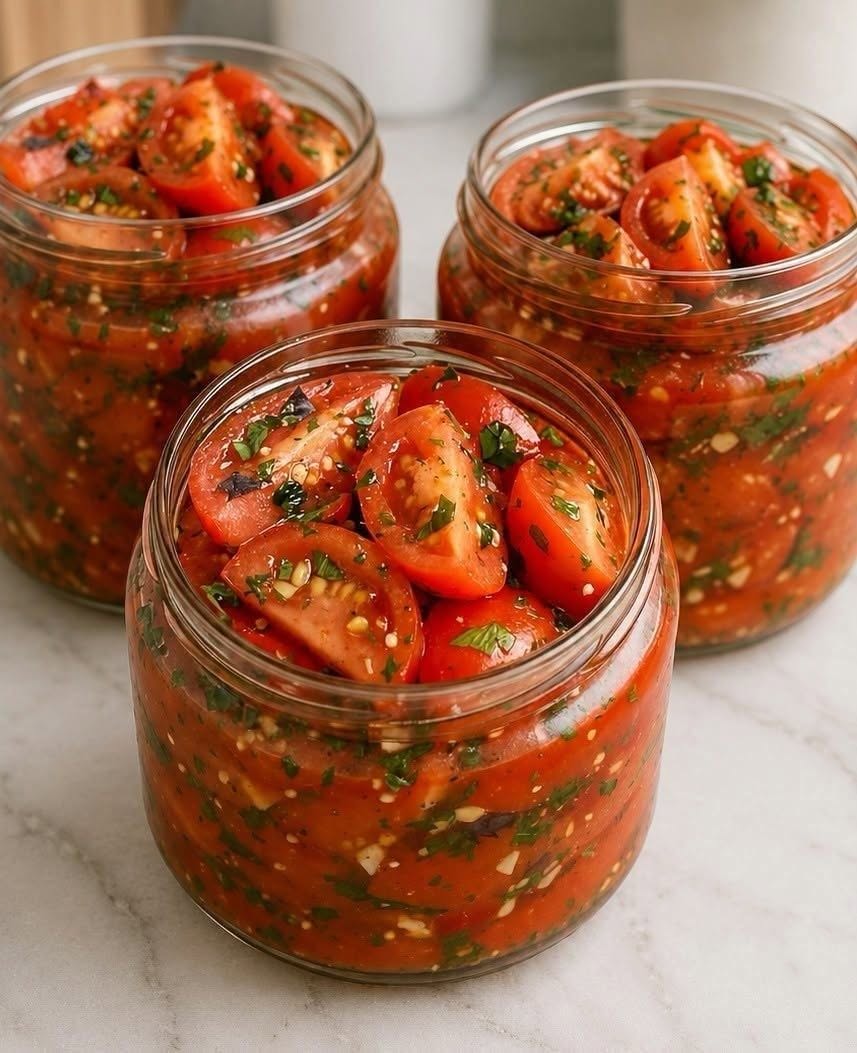
Korean-style tomatoes are a colorful and flavorful pickle with bell peppers, chilies, garlic, and fresh herbs. The flavor is sweet and sour, slightly hot, and aromatic, and the tomatoes are great as a side dish for grilled chicken, rice dishes, potatoes, salads, and buffets.
However, there is one important thing to correct in the original recipe: you can’t promise that raw tomatoes with garlic, herbs and oil will last until New Year’s without a tested preservation method. Oil creates an oxygen-poor environment, and the Swedish Food Agency emphasizes that home-preserved and oil-pickled vegetables must be handled correctly to reduce the risk of, among other things, botulism.
This version is therefore made as a refrigerator preserve for relatively quick consumption , not as a pantry preserve.
Ingredients
For a large batch:
- 2 kg firm, ripe tomatoes
- 2–3 peppers, preferably red and yellow
- 1–2 fresh chilies
- 1–2 heads of garlic
- 1 large bunch of fresh herbs, such as parsley, dill or coriander
For the marinade
- 1 dl vinegar, 12%
- 2 cups water
- 100 g granulated sugar
- 2 tsk salt
- 1 tsp ground coriander, optional
For serving
- a little neutral oil or olive oil
Instead of storing the tomatoes in oil for a long time, the oil is added here only when serving. This gives the same rounder taste without creating an oil pickling that requires special care. The Swedish National Food Agency describes oil-pickled vegetables as a situation where Clostridium botulinum can have favorable conditions if cooking and storage are not correct.
Choose firm tomatoes
This recipe works best with tomatoes that are ripe but still firm.
Good options are:
- plum tomatoes
- San Marzano-typ
- firm small tomatoes
- fleshy tomato varieties with relatively little liquid
Avoid overripe tomatoes. They will quickly soften when mixed with the marinade.
Prepare the jars
Use clean glass jars with tight-fitting lids.
Wash jars and lids thoroughly and let them dry.
Since this variant is to be refrigerated, the vacuum seal is not what makes it safe. The jars should be kept cold at all times.
Prepare the tomatoes
Rinse the tomatoes and dry them.
Small tomatoes can be cut in half.
Larger tomatoes are cut into wedges.
Cut the chili into smaller pieces. Remove the seeds if you want a milder heat.
Chop the herbs coarsely.
You can then either finely chop everything by hand or pulse briefly in a food processor.
The mixture should be quite fine but not completely pureed.
Make the marinade
Pour water, sugar, salt and any ground coriander into a saucepan.
Bring to a boil and stir until the sugar has dissolved.
Remove the saucepan from the heat and add the vinegar.
Let the mixture cool until it is lukewarm.
Stir in tomatoes and spice mixture
Place a thin layer of the paprika, chili, garlic and herb mixture in the bottom of each jar.
Add a layer of tomatoes.
Continue to rotate until the jar is almost full.
Pour the marinade over the tomatoes so that it is evenly distributed.
Do not press the vegetables together too tightly.
Let the tomatoes marinate
Put the lids on and place the jars in the refrigerator.
They are good after just one day, but the flavor develops more clearly after about 2–3 days.
During this time, the tomatoes also release some of their own liquid, which mixes with the marinade and spices.
Please turn the jar carefully sometime during the first day so that the flavors are distributed.
Why the original durability is questionable
The original claims that tomatoes can last a very long time thanks to:
- vinegar
- garlic
- chili
- oils
But garlic and chili are not reliable preservatives that make a raw vegetable pickle safe for several months of storage.
For pickled vegetables, the correct acidity level is crucial. The Swedish National Food Agency describes that the purpose of pickling is to lower the pH so much that bacterial growth is inhibited, and recommends proven recipes for safe home preservation.
Therefore, oil is better when serving
Oil rounds out the acidity and makes the flavor richer, but it also changes the environment around the vegetables.
Clostridium botulinum multiplies in an oxygen-poor environment and can under certain circumstances form a very potent toxin. The Swedish Food Agency emphasizes that the risk is unusual but serious and that oil-pickled vegetables require proper heat treatment and refrigeration.
Therefore, it’s better to drizzle a little oil over the tomatoes when they’re on the plate.
How strong should the tomatoes be?
Start carefully with the chili.
For 2 kg of tomatoes, you usually need:
- 1 mild chili for light heat
- 1–2 stronger chilies for distinct heat
The strength of chili varies greatly between varieties.
It’s easier to add more heat next time than to salvage a batch that’s too strong.
Korean inspiration – but not a traditional Korean dish
The name “Korean-style tomatoes” is often used for this type of Eastern European internet recipe with garlic, chili, coriander, and sweet and sour marinade.
It’s better to view the recipe as Korean-inspired marinated tomatoes than as an authentic traditional Korean tomato dish.
The flavor profile, however, is distinctly spicy, garlicky and sweet and sour.
How to get the best consistency
Choose the right tomatoes
Firm and fleshy varieties keep much better.
Don’t cut too thin
Wedges hold their shape better than thin slices.
Keep cold
Cold storage slows down both quality changes and microbial growth.
Prefer to make smaller batches
This type of fresh marinated vegetable tastes best when eaten relatively soon.
It’s better to make a new batch than to store the same jar for months.
Variation with coriander
Coriander is especially good if you want to enhance the Asian-inspired flavor.
Use both:
- fresh coriander
- a little ground coriander in the marinade
The fresh herb adds freshness while the ground spice adds a warmer, citrus-like note.
Variation with ginger
Add about 1 tablespoon of finely grated fresh ginger to the vegetable mixture.
It goes well with chili and garlic and makes the taste even healthier.
Variation with milder garlic flavor
One or two whole heads of garlic give a strong flavor.
If you want a milder version, about 5–6 large garlic cloves are enough.
The garlic flavor also becomes slightly rounder after a couple of days in the marinade.
Serving tips
Serve the tomatoes with:
- grilled chicken
- fried beef
- to him
- noodles
- roasted potatoes
- grilled vegetables
- vegetarian steaks
- salads
- wraps
Feel free to drizzle a little oil over just before serving.
Quick salad with marinated tomatoes
Add the tomatoes along with some of the onion or pepper mixture from the can.
Add:
- thinly sliced cucumber
- fresh coriander or parsley
- a few drops of sesame oil
- roasted sesame seeds
Then you get a quick salad with lots of flavor.
Common mistakes to avoid
Storing the jars at room temperature
This version is a refrigerator insert.
It should not be kept in the pantry or cellar.
Believing that garlic preserves food
Garlic adds flavor, but does not replace proper acidification or safe heat treatment.
Too much oil in the can
Add the oil when serving instead.
Overripe tomatoes
They quickly become mushy.
Too little acid in a recipe that will be stored for a long time
For such preservation, a tested recipe should be used and the proportions should be followed carefully.
Storage
Store the jars in the refrigerator, preferably around 4 °C.
Use clean utensils when removing tomatoes from the can.
Since this is a fresh refrigerator preserve, it should not be treated as a product with a guaranteed shelf life of several months.
It’s better to make smaller quantities and use them while the tomatoes still have good flavor, aroma and texture.
Discard the entire can if you notice:
- mildew
- swollen lid
- leakage
- slimy consistency
- severe unexpected flatulence
- distinctly different smell
Never taste suspicious home-canned food to determine if it is safe.
If you want to store tomatoes for the winter
If you really want to make a larger winter stock, you should use a recipe that is explicitly tested for safe home preservation.
The Swedish National Food Agency recommends proven recipes and describes that low-acid vegetables that are to be home-preserved in some cases need to be treated in a special pressure cooker for preservation, where a sufficiently high temperature can be achieved.
A recipe for long-term storage should therefore state:
- exact amount of raw material
- exact acid strength
- amount of water
- jar size
- temperature
- processing time
- correct storage
Frequently asked questions
Can I use apple cider vinegar?
For a regular refrigerator pickling, different types of vinegar can provide good flavor, but their acidity levels vary. Follow a specified acidity level rather than swapping freely if the recipe is intended for canning.
Can I use cherry tomatoes?
Yes. Choose firm varieties and cut them in half.
Can I exclude coriander?
Yes. Parsley and dill work well and give a milder flavor.
Do I have to use chili?
No. The recipe can be made mild, but then some of the characteristic flavor will be lost.
Can I add the oil directly to the jar?
For this version, it is easier and safer to add the oil when serving.
Do they really last until New Year’s?
It is not possible to make any promises based on the original recipe. Without a tested preservation process, these tomatoes should be treated as a refrigerator preserve for relatively quick consumption, not as a winter preserve.
Spicy tomatoes that get better after a few days
What makes these tomatoes interesting is the combination of acidity, sweetness, chili, garlic and fresh herbs. After a couple of days in the refrigerator, the flavors become much more cohesive and the tomatoes acquire an aromatic marinade that works with many different dishes.Make them as a fresh fridge preserve, choose firm tomatoes and add any oil only when serving. This will give you the strong, spicy flavor that has made the recipe popular, but with much safer storage.