
At the top, I had written one sentence.
This was the day I stopped confusing access with love.
Fiona’s envelope was different.
It contained the hospital intake form.
Emergency contacts.
Laura.
Michael.
Fiona.
Beside it was the benign biopsy result.
Fiona read it and broke.
Not dramatically.
Not loudly.
She simply sat down and started crying into both hands.
“She went through that alone,” she said.
Nobody answered.
Because no answer could make it smaller.
The lawyer gave them the last page.
It was not a curse.
It was not revenge.
It was a boundary.
I wrote that I was alive.
I wrote that I was safe.
I wrote that I did not want visits, demands, apologies performed under pressure, or arguments about money.
If they wanted a relationship with me, they could write one letter each.
Not a text.
Not a voicemail.
A letter.
They could tell me one thing they remembered about me that had nothing to do with what I had given them.
Then they could wait.

For once, I would be the one who decided whether to answer.
Laura left angry.
Michael left threatening lawyers he never hired.
Fiona stayed in the conference room after the others were gone.
She asked my lawyer if I was eating.
It was the first practical question any of them had asked in years.
He told her he could not share details.
She nodded.
Then she folded the hospital form carefully and put it back in the envelope like it was something fragile.
Two weeks later, I received three letters.
Laura’s came first.
It was four pages of explanation.
Work had been stressful.
The kids had schedules.
Holidays were complicated.
Grief had been hard for everyone.
She wrote many words without once writing sorry.
I put it in a drawer.
Michael’s came second.
It was one page.
He said I had embarrassed the family.
He said Richard would never have wanted this.
He said I was being manipulated.
I put that one in the trash.
Fiona’s came last.
It was written on plain notebook paper.
The handwriting shook.
Dear Mom, it began.
I remember you cutting my toast into triangles because I said squares tasted wrong.
I remember Dad pretending not to notice when you slipped me twenty dollars before school trips.
I remember you staying up all night sewing my angel costume for the church pageant because I forgot to tell you until the night before.
I remember you.
Then she wrote the sentence that made me sit down.
I am ashamed that I remembered the inheritance more clearly than I remembered the mother.
I read that line three times.
Then I cried.
Not because it fixed anything.
It did not.
One true sentence does not rebuild a decade.
But it was the first true sentence one of my children had given me in years.
I wrote back to Fiona one month later.
Only to Fiona.
I told her I was safe.
I told her I was not ready to see her.
I told her that if she wanted to begin again, she could begin by showing up consistently for someone who could no longer be bought with last-minute affection.
She wrote every month after that.
Sometimes I answered.
Sometimes I did not.
Laura sent flowers on Mother’s Day.
I donated them to the senior center.
Michael did not write again.
That, too, was an answer.
By summer, my small apartment had begun to feel like mine.
I hung Richard’s photograph near the kitchen window.
I bought a yellow chair.
I learned the names of two women down the hall.
I started volunteering twice a week at the church kitchen.
The first time I carried trays into the dining room, a little boy with ketchup on his sleeve told me the mashed potatoes were good.
I almost laughed at the sweetness of it.
After all those years cooking for people who could not be bothered to come, a stranger’s child looked me in the eye and thanked me for potatoes.
Life is strange that way.
It does not always give back what was taken.
Sometimes it gives you proof that you were not foolish for wanting to give in the first place.
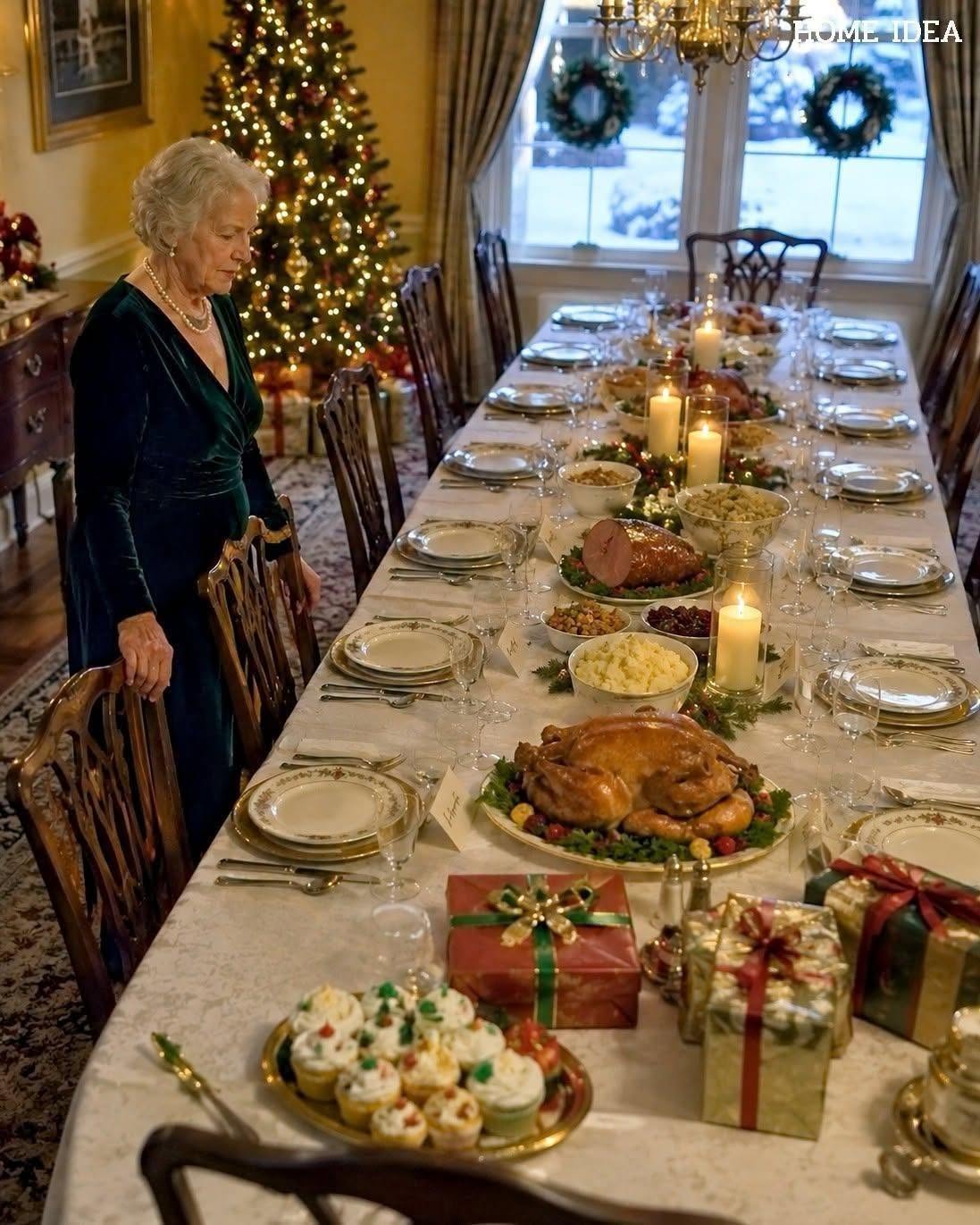
On the next Christmas Eve, I did not cook for seventeen people.
I cooked for six women from my building, two volunteers from the kitchen, and one widower who brought store-bought pie and apologized for it three times.
I wore the green velvet dress.
I wore Richard’s pearls.
At 8:40 p.m., I looked at the clock above the stove in the community room and felt the old pain brush against me.
But it did not own the room.
People were laughing.
Someone spilled cider.
The widower’s pie was too sweet.
A woman named June asked for Richard’s pecan bread recipe.