

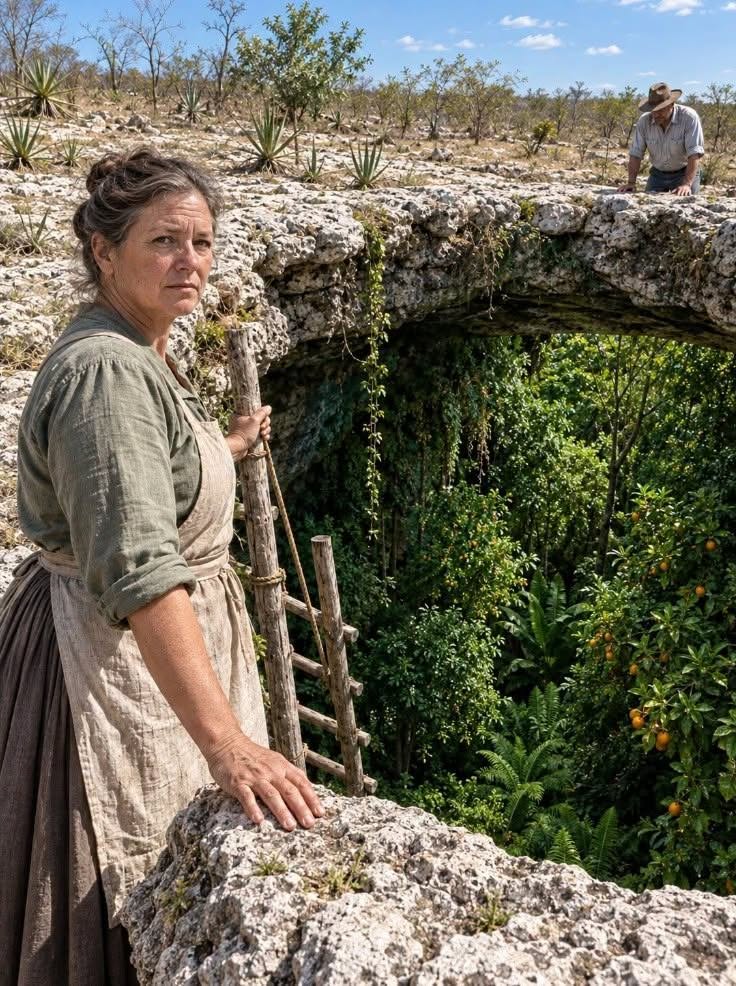
Part 1
The rope was tied around an old white oak when Margaret Hale lowered herself over the limestone ledge.
Her brother Daniel stood above her with both hands wrapped around the other end.
“You slip, Maggie, I’m not catching you.”
Margaret looked down into the shadow beneath her boots.
“Then don’t let go.”
“That isn’t reassuring.”
“It wasn’t supposed to be.”
She lowered herself another foot.
At fifty-five, Margaret knew perfectly well that climbing into a thirty-eight-foot sinkhole on a piece of abandoned Tennessee farmland was not the sort of thing sensible women were supposed to do on a Tuesday morning.
That was what Daniel had told her.
It was also what the realtor had implied.
And it was certainly what most people around Cedar Ridge believed when Margaret Hale paid cash for twelve rocky acres that had changed hands only once in nearly twenty years.
Nobody wanted the place.
That was why Margaret could afford it.
The property sat in a limestone belt of Middle Tennessee, several miles outside a small farming town where pasture, cattle, corn and hay were the ordinary language of land.
Margaret’s twelve acres spoke a different language.
Rock.
Cedar scrub.
Thin soil.
More rock.
The old county listing called it “unimproved acreage.”
One neighboring farmer had a less polite description.
“Goat country.”
The realtor had laughed when he repeated that.
Margaret had not.
She had spent almost twenty years running a small market garden behind the house she and her late husband, Tom, had owned on the edge of town.
Tom had died four years earlier.
Afterward, Margaret kept the house, the garden and the routines that had accumulated around both.
She grew tomatoes, peppers, beans, herbs and berries. She sold some at a Saturday farmers market and preserved the rest.
But the backyard was too small for what she wanted.
Margaret wanted enough land for a serious orchard and vegetable operation.
She wanted fruit trees.
She wanted production.
She wanted something that could become a business rather than an oversized garden.
Good bottomland was beyond her budget.
Improved acreage with deep soil was worse.
Then she found the twelve acres on County Road 214.
Everyone else saw the limestone.
Margaret saw two sinkholes.
The larger one was almost invisible from the road.
Trees and brush crowded its rim. From above, all anyone could see was a dark opening beneath tangled branches.
Margaret had noticed it the first afternoon the realtor showed her the property.
“How deep?”
He shrugged.
“Never measured it.”
“Has anyone been down?”
“Not that I know of.”
“What’s at the bottom?”
Another shrug.
“Rocks, probably.”
That answer stayed with her.
Probably.
Three months earlier, Margaret had attended a county extension workshop on growing food in karst landscapes.
Most of the other attendees had been interested in drainage problems, soil loss and managing livestock around sinkholes.
Margaret had been interested in something else the extension specialist mentioned almost in passing.
Cold sinks and sheltered depressions could create their own microclimates.
Some accumulated deeper soil.
Some retained moisture.
Some protected vegetation from wind.
They were not automatically good farmland.
Many were dangerous.
Some drained too quickly.
Others flooded.
But a depression in limestone country could behave very differently from the ground surrounding it.
Margaret remembered writing one sentence in the margin of her handout.
Don’t judge the bottom from the rim.
So when she saw the sinkholes on County Road 214, she kept asking questions.
Nobody had answers.
Eventually she bought the property.
Now, six days after closing, she was climbing into the larger one.
The temperature changed first.
At the surface, late March sunshine had already warmed the exposed rock.
Ten feet down, the air became cooler.
Twenty feet down, the wind disappeared.
Margaret stopped.
“Everything okay?” Daniel called.
“Yes.”
“You sure?”
“Yes.”
She continued.
Then she smelled something she had not expected.
Earth.
Not limestone dust.
Not dry leaves.
Earth.
Her boots reached the bottom.
Margaret loosened the rope from around her body and turned.
For several seconds, she did not move.
The floor of the sinkhole was perhaps sixty feet across at its widest point.
Black soil covered most of it.
Ferns grew along the shaded edges.
Moss covered fallen limbs.
And near the southern wall stood two old apple trees.
Margaret stared at them.
They were crooked and badly neglected.
One had lost a major branch.
Wild grapevine had climbed through the crown of the other.
But both were alive.
And both were flowering.
A third tree stood farther back.
Pear.
Margaret walked toward it.
The trunk was old enough that she could not close both hands around it.
She crouched and pushed her fingers into the ground.
They sank into dark, loose soil.
She dug deeper.
The soil underneath was cool.
Damp.
Margaret looked toward the circle of sky overhead.
The surface had gone almost three weeks without meaningful rain.
She touched the soil again.
Moisture.
“Margaret?”
Daniel’s voice echoed down the limestone.
“What do you see?”
She looked at the apple blossoms.
“Trees.”
“What kind?”
“Apple. And a pear.”
There was a pause.
“That’s it?”
Margaret smiled.
“No.”
“What else?”
She grabbed a handful of soil.
“About twelve acres more than we thought we bought.”
Daniel did not understand what she meant until Margaret climbed back up.
He pulled her over the final ledge and helped her stand.
She was dirty from her knees down.
“Well?”
Margaret opened her fist.
Black soil lay in her palm.
Daniel looked at it.
Then at the limestone beneath their boots.
“Where did that come from?”
“The bottom.”
“How much?”
“I don’t know yet.”
He leaned over the rim.
“You bought twelve acres because there’s dirt in a hole?”
“I bought twelve acres because nobody bothered to find out what was in the hole.”
Daniel looked across the property.
His expression said what he was too polite to say.
Margaret had lost her mind.
She heard the same thing from someone with considerably more agricultural authority three weeks later.
His name was Eric Lawson.
Eric was an agricultural extension agent who had worked with farmers across the county for almost eighteen years.
Margaret invited him out because she wanted criticism.
Real criticism.
Not gossip.
Eric walked the property slowly.
He kicked at the thin soil with his boot.
Examined exposed limestone.
Studied the brush.
Then stood at the rim of the large sinkhole.
“You want to put an orchard down there?”
“Part of one.”
“How are you getting equipment in?”
“I’m not.”
Eric looked at her.
“You’ll need equipment eventually.”
“Maybe.”
“How are you irrigating?”
“I haven’t decided yet.”
“And how are you getting a harvest out?”
“Same way I get myself out.”
Eric leaned over.
“That’s a long way to carry produce.”
“I know.”
“Those walls need to be inspected too. Limestone breaks. You could have rockfall.”
“I know.”
“You’ll have airflow issues in certain weather.”
“I know.”
Eric finally smiled.
“You say that a lot.”
“Because you keep pointing out real problems.”
“That usually discourages people.”
“I didn’t ask you to encourage me.”
That stopped him.
Margaret continued.
“I asked you to tell me what can kill the project.”
Eric looked back into the sinkhole.
“Access can.”
“Good.”
“Drainage can. Depending on what happens in heavy rain.”
“Good.”
“Disease pressure can if the humidity stays high.”
Margaret nodded.
“What else?”
He studied her for a moment.
Then his tone changed.
They spent another hour walking the property.
Eric did not tell her the idea was impossible.
But he did tell her something close.
If Margaret wanted commercial fruit production, there were easier places to do it.
Land with deeper conventional soil.
Land where a tractor could move.
Land where irrigation lines could be installed normally.
Land where nobody needed a rope to reach an apple tree.
Margaret agreed with every word.
She simply could not afford those places.
The second skeptic was Ray Collins.
Ray owned the adjoining cattle property.
He was sixty-three, broad-shouldered, permanently sunburned and suspicious of anything that sounded like an experiment.
His family had farmed around Cedar Ridge since his grandfather’s time.
When Margaret told him what she intended to do, Ray removed his cap.
“You’re planting inside that sink?”
“Yes.”
“You know water runs downhill?”
“I’ve heard rumors.”
Ray ignored the joke.
“A big storm comes through, that bottom could turn into a bathtub.”
“That’s why I’m watching it before planting.”
“Snakes?”
“Probably.”
“Ticks?”
“Definitely.”
“Falling rock?”
“Eric already gave me that one.”
Ray put his cap back on.
“People have owned that place a long time, Maggie.”
“Yes.”
“Nobody farmed that hole.”
“Not recently.”
“There might be a reason.”
Margaret looked toward the old pear tree visible through the branches.
“There might also be a reason somebody planted fruit trees down there.”
Ray had no answer for that.
The third skeptic was Caroline Webb.
Caroline bought produce for two farm shops and several restaurants in Nashville.
Margaret had sold her small quantities of herbs and peppers before.
When Margaret explained her plans, Caroline listened without interrupting.
Then she asked the question that mattered.
“How much can you supply?”
“Not much at first.”
“That’s the problem.”
“I know.”
“Restaurants don’t want a beautiful story about twelve pounds of apples. They want to know whether I can get another forty pounds next Thursday.”
“I understand.”
“You need volume and consistency.”
“I understand that too.”
Caroline sighed.
“I like you, Margaret.”
“I hear bad news coming.”
“You’re trying to build a commercial operation in a hole.”
“Partly.”
“With stairs.”
“Eventually.”
“You don’t even have stairs yet.”
“Eventually,” Margaret repeated.
Caroline laughed.
“Call me when the hole starts producing.”
“I will.”
Margaret drove home without feeling insulted.
All three people had given her useful information.
Eric saw technical limitations.
Ray saw physical danger.
Caroline saw market reality.
Margaret wrote all three categories in a notebook that night.
ACCESS.
WATER.
MARKET.
Then she added a fourth.
PROVE IT.
Access came first.
A rope was acceptable for exploration.
It was ridiculous for farming.
Daniel had worked construction most of his adult life. Once he accepted that Margaret was not selling the property, his skepticism became practical.
They studied the north wall of the sinkhole.
Natural limestone shelves created several possible anchor points.
Instead of a straight ladder, Daniel suggested building a steep switchback staircase in sections.
“If we do this,” he said, “we do it once.”
Margaret looked at him.
“You mean correctly.”
“I mean so I don’t have to come rebuild it after you fall through it.”
They used pressure-treated timber for the main structure, galvanized hardware and heavy posts anchored wherever the geology allowed safe placement.
A thick rope handrail ran along exposed sections.
Daniel added anti-slip treads.
Margaret tested every stage herself.
It took nearly a month.
When the last section was finished, they stood at the top.
Daniel looked down.
“You realize most people build stairs to a porch.”
“Most people bought better land.”
“You finally admit it?”
“I bought cheaper land.”
“That isn’t the same thing.”
“Exactly.”
She went down carrying a shovel.
For the next seven weeks, Margaret cleaned.
The old apple trees were buried in vines.
The pear had deadwood throughout its crown.
Bush honeysuckle and other invasive growth crowded parts of the floor.
Margaret cut everything by hand.
Nothing was burned.
Smoke in a deep enclosed depression was an unnecessary risk, and the organic material had value.
She hauled cut vegetation to a compost area near the rim.
When the material broke down, she intended to return it to the soil.
One afternoon Daniel met her halfway up the stairs.
She was carrying a sack of cut vines.
He took it from her.
“How many trips today?”
“Eight.”
“You know there are gyms where people pay to do this?”
“Idiots.”
Daniel laughed.
By May, the bottom looked different.
Light reached the old fruit trees.
Margaret could walk from one end to the other without fighting vines.
Now she needed to know what she actually had.
She drove a steel soil probe into the ground.
One foot.
Two.
Three.
Four.
Margaret stopped.
She pulled it out.
Then tried another location.
Again, deep soil.
She sampled six points.
See more on the next page
Advertisement
The depth varied, but in the best sections there was more than four feet of accumulated soil before she hit serious resistance.
Four feet.
On a property where some surface areas barely had enough soil to hide the limestone.
Margaret sat on an overturned bucket beneath the old pear tree.
For the first time since buying the property, she allowed herself to imagine what the place might look like in five years.
Not what she hoped.
What it could actually support.
She opened her notebook.
Under PROVE IT, she wrote:
Start small.
That fall, she planted.
Apples suited to the region.
Pears.
A small block of pawpaw in the more protected section.
Blackberries where the light was stronger.
Between the young trees, she used temporary vegetable beds for peppers, greens and radishes.
She did not fill every available foot.
That would have been greed disguised as ambition.
She wanted to learn how the sinkhole behaved first.
The second, shallower depression received more sun.
There she planted additional berries and vegetables.
Then Margaret waited for the first serious rain.
It came in November.
For six hours, rain hammered Cedar Ridge.
Water crossed the exposed limestone.
Ditches filled.
Ray’s cattle stood under trees along his fence.
Margaret put on a rain jacket and walked to the sinkhole.
Daniel had specifically told her not to.
She went anyway.
Water was moving down the walls.
Small streams appeared through cracks in the limestone.
Runoff entered from several points.
Margaret watched the bottom.
It became wetter.
But it did not become a lake.
The soil absorbed.
Fractures carried water away.
The next morning she returned.
No standing flood.
Three days later, she dug into the soil.
Still moist.
A week later.
Still moist.
Two weeks.
Moist below the surface.
Margaret wrote everything down.
Dates.
Rainfall from her gauge.
Soil observations.
Temperature.
She began measuring the difference between the rim and the bottom during hot afternoons.
Sometimes it was small.
Sometimes it was remarkable.
Five degrees.
Seven.
On certain afternoons, nearly ten degrees Fahrenheit cooler in the most shaded areas.
The sinkhole was not simply lower ground.
It behaved like a different place.
By the end of the first full growing season, the young trees were establishing well.
Better than Margaret expected.
She still had no permanent irrigation system.
During dry spells, she watered new plantings when necessary, especially during establishment, but the amount of supplemental water required was far less than she had feared.
The deeper soil retained moisture.
Shade reduced evaporation.
The walls reduced wind.
Her strange farm began producing vegetables.
Not much.
Enough.
Enough to carry crates up the stairs.
Enough to sell.
Enough for Caroline Webb to raise an eyebrow when Margaret delivered peppers one Saturday.
“These came from the hole?”
“The hole.”
Caroline picked one up.
“I thought you were growing fruit.”
“Fruit takes time.”
Caroline smiled.
“So you grew cash flow while you waited.”
Margaret shrugged.
“I grew peppers.”
But the question was no longer whether something could grow there.
The question was what happened when conditions became difficult.
The answer came the following summer.
Part 2
June began hot.
By the middle of the month, people stopped describing it as unusually warm.
It was simply hot.
Every day.
Morning temperatures rose early.
Afternoon heat settled over the pastures.
Rainfall became scattered and unreliable.
Storms appeared on weather apps, broke apart and disappeared.
July was worse.
Grass around Cedar Ridge browned.
Ray started feeding hay earlier than he wanted.
Creeks shrank.
Ponds dropped.
Farmers with irrigation used it heavily.
Those without it watched the sky.
Margaret watched the soil.
At the surface of her property, vegetation crisped.
The limestone reflected heat.
Inside the large sinkhole, the story was different.
The upper inch of soil dried.
Below it, moisture remained.
Margaret pushed her fingers down.
Cool earth.
She checked another bed.
The same.
The young apples showed stress, but not severe stress.
The pears held.
The berries needed attention in the sunnier sections.
The vegetables required some supplemental watering.
But the protected core of the planting remained astonishingly stable.
Margaret did not call it a miracle.
Miracles were poor farm-management plans.
She called it stored water.
Deep soil.
Shade.
Reduced wind.
Topography.
She continued recording everything.
Then August arrived.
The drought deepened.
Ray’s pasture deteriorated.
He moved cattle from one section to another trying to preserve forage.
Hay prices climbed.
Several small produce growers Margaret knew lost plantings.
Vegetables suffered.
Young fruit trees on exposed ground needed constant irrigation.
Caroline began calling suppliers farther from Nashville.
Local availability became inconsistent.
One afternoon, Eric Lawson drove onto Margaret’s property.
She was at the compost pile.
He got out holding a notebook.
“How’s the experiment?”
Margaret pointed toward the sinkhole.
“Go look.”
Eric walked to the rim.
He stared down.
Then turned.
“You irrigating?”
“Some establishment water. Less than I expected.”
“How much less?”
“I have records.”
That interested him.
They descended.
At the bottom, Eric stopped beside one of the young pear trees.
He examined the leaves.
Then the soil.
“How long since you watered here?”
Margaret told him.
Eric crouched and dug several inches down.
His expression changed.
He moved five yards and checked again.
Then another spot.
“Still moist.”
“Yes.”
“After this heat.”
“Yes.”
He stood.
“How much temperature difference are you getting?”
“Depends on time and location. Usually several degrees. More in the shaded zones during peak afternoon heat.”
“You measured?”
Margaret handed him the notebook.
Eric read.
After a minute he looked at her.
“You really wrote all of this down?”
“You told me I was running an experiment.”
“I didn’t think you’d take me literally.”
“I take everybody literally when they doubt me.”
Eric laughed.
They spent almost two hours below.
He measured trunk growth.
Photographed the layout.
Asked about drainage during heavy rainfall.
Margaret showed him her notes.
Finally he closed the book.
“This is worth documenting properly.”
“You mean my hole?”
“I mean your production system.”
“Sounds more respectable when you say it.”
Eric ignored that.
“I’d like to bring some extension people out. Maybe a horticulture group.”
Margaret looked up the stairs.
“Make sure they wear boots.”
Ray arrived four days later.
He did not call first.
Margaret found him standing at the rim.
“You busy?” he asked.
“Yes.”
He nodded.
“Can I go down?”
Margaret almost asked why.
Instead she moved aside.
“Watch the third section. It stays slick.”
Ray descended.
At the bottom, he walked slowly.
He examined the apple trees.
Then the pears.
Then the vegetable beds.
He knelt and pushed his hand into the soil.
Margaret watched without speaking.
Ray stood.
“My pasture’s cooked.”
“I know.”
“Pond’s down more than two feet.”
Margaret nodded.
He looked around.
“You got water hidden down here?”
“No.”
“Then explain this.”
Margaret pointed toward the walls.
“Rain comes in. Soil stores it. Shade keeps it longer. Less wind.”
“That simple?”
“No. Nothing involving farming is that simple.”
Ray almost smiled.
He walked toward the old pear tree.
“This thing was here when you bought the place?”
“Yes.”
“How long you think it’s been here?”
“No idea.”
Ray touched the trunk.
Then he asked a question Margaret had not expected.
“You ever look at that sink on my north forty?”
“Yes.”
His eyes narrowed.
“You went onto my property?”
“I looked from the fence.”
Ray nodded.
“Think it’s like this one?”
“I don’t know.”
“How do we find out?”
Margaret looked toward the stairs.
“We go down.”
Ray glanced upward.
“I was afraid you’d say that.”
A week later, Daniel helped Ray build safe temporary access into his own depression.
It was smaller.
Shallower.
The soil was not as deep as Margaret’s.
But it was there.
Dark.
Cool.
Moist below the surface.
Ray stood at the bottom and stared.
“My granddad owned this.”
Margaret said nothing.
“My dad owned it.”
She waited.
“I’ve owned it thirty-one years.”
Ray pushed his boot into the soil.
“Never came down here.”
Margaret looked up.
“Most people don’t.”
Ray shook his head.
“Thirty-one years.”
The drought continued.
By late August, Caroline Webb had a different problem.
She had customers.
She did not have enough local produce.
Restaurant buyers who normally specified exact sizes and varieties became more flexible.
Farm shops paid premiums for reliable regional supply.
Transportation costs made distant produce less attractive.
Caroline called Margaret.
“How much can you give me this week?”
“Of what?”
“Anything good.”
Margaret smiled.
“That’s not what you said two years ago.”
“I said I needed volume and consistency.”
“You said a farm in a hole wasn’t going to give me either.”
There was silence.
Then Caroline laughed.
“Are you going to make me apologize before you sell me food?”
“No.”
“Good.”
“Because the price is enough.”
Another silence.
“That sounds like a yes.”
Margaret gave her the available quantities.
Peppers.
Greens.
Berries.
A limited amount of early fruit.
Not enormous volume.
But dependable volume.
That mattered.
Caroline agreed to take it.
When she arrived, Margaret made her climb down.
Caroline reached the bottom, looked around and slowly turned in a circle.
“You’ve got to be kidding me.”
Margaret was carrying an empty crate.
“About what?”
“It doesn’t look like Tennessee down here.”
“It is Tennessee.”
“You know what I mean.”
Margaret did.
Above them, August had turned the exposed landscape brown.
Down here, leaves were green.
Caroline crouched and touched the soil.
“This is why?”
“Partly.”
Caroline looked at the limestone walls.
“And these.”
“Partly.”
“The shade?”
“Partly.”
“The drainage?”
“Partly.”
Caroline stood.
“So what’s the secret?”
Margaret handed her the empty crate.
“There isn’t one.”
Caroline stared at it.
“What’s this?”
“You wanted produce.”
“Yes.”
“It has to get upstairs.”
“You’re making me carry it?”
“You wanted to understand the operation.”
Caroline laughed so loudly the sound bounced off the limestone.
That afternoon she understood the other half of Margaret’s farm.
The sinkhole protected the crops.
It also trapped the farmer at the bottom of a thirty-eight-foot staircase with every pound she harvested.
There was no loading dock.
No tractor.
No utility vehicle.
Every crate moved by human effort.
Caroline reached the top carrying half a load and set it down.
“Your price just went up.”
Margaret smiled.
“Now you understand.”
By September, the story had spread beyond Cedar Ridge.
People came because they had heard about “the sinkhole orchard.”
See more on the next page
Advertisement